
Inside the Dukes County Most Wanted Program
Look through the Dukes County Sheriff's Office website and you will find the jail, Civil Process, a regional communications center, an executive office, and community programs. No most wanted page. No outstanding warrant roster, and no Crime Stoppers list for the island. Dukes County fugitive outreach runs through the state program instead. So if some other site claims to host a Dukes County wanted roster, treat it as unofficial and verify the source before you lean on it.
Massachusetts State Police Runs the Statewide Program
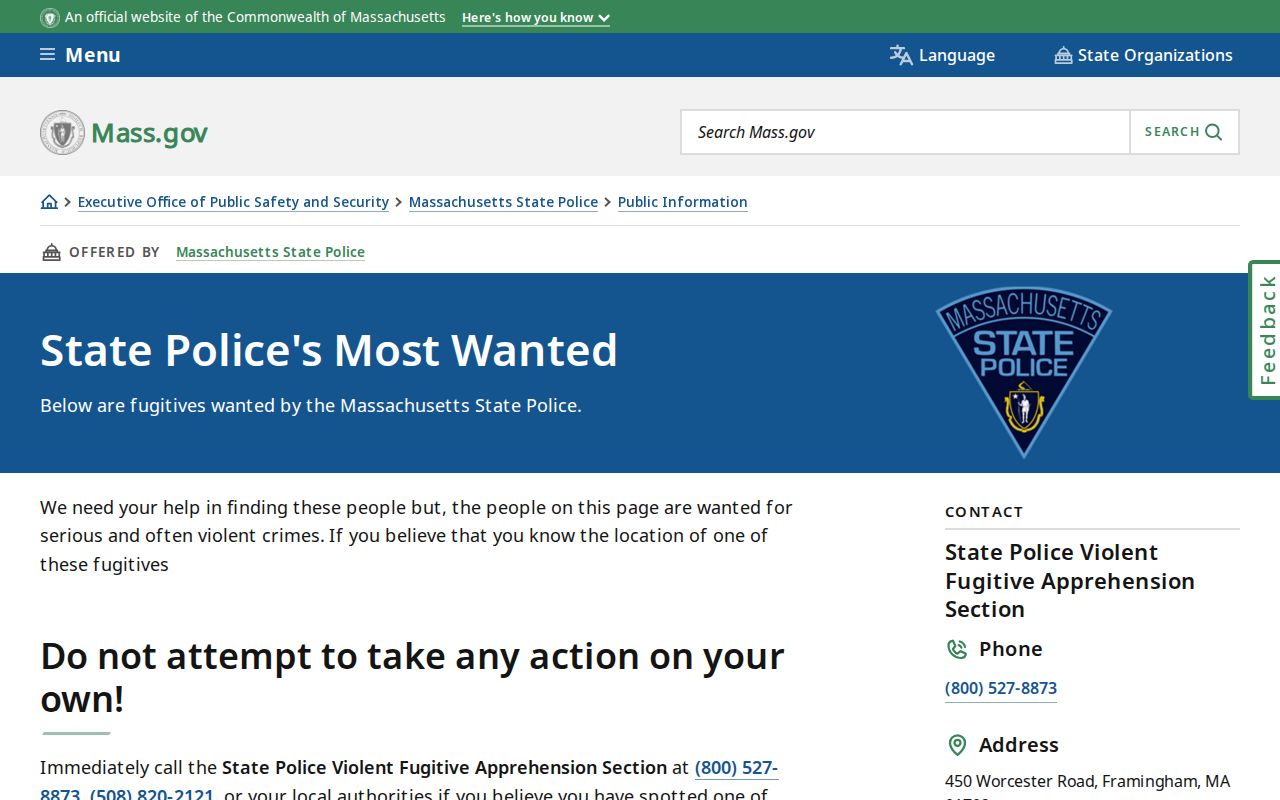
The Massachusetts State Police Most Wanted page belongs to the Violent Fugitive Apprehension Section. It asks anyone who believes they have spotted a listed person to call the section or local authorities at once, and to take no action alone. The page carries tip numbers and poster links. It is statewide and curated, not a Dukes County list.
Massachusetts State Police Most Wanted
Violent Fugitive Apprehension Section
(800) 527-8873
(508) 820-2121
The state program page shows the program heading, the tip instructions, and the do-not-approach warning. It lists no Dukes County profiles.
The program is outreach only, never a substitute for the court record in Dukes County.
How Dukes County Most Wanted Lists Work
A most wanted list is a selection, not an inventory. State police pick a handful of cases for public attention, usually serious or violent ones where tips might locate a person. The full set of outstanding warrants never makes that page, and Dukes County publishes no list of its own. So a name missing from a wanted page tells you nothing about case status. For a specific Dukes County matter, ask the court that issued the docket.
No Dukes County Roster Was Located
The sheriff's navigation, contact, news, and division pages carry no county or town warrant roster, and neither do the five largest town police sites. Dukes County simply posts none. That is why people bounce from site to site hunting a list that was never there. The working substitute is a court docket plus a clerk confirmation, laid out on the active warrant search page.
Sending a Most Wanted Tip Safely
A tip is information, not an arrest. One rule outranks the rest: never approach someone you believe is listed. Call the section or local authorities instead. An emergency still goes to 911. Anything routine in Dukes County belongs with the tip line, the town police non-emergency number, or the sheriff's dispatch channel.
Key Rule: Never confront, follow, or photograph a person you believe is wanted. Report what you know, leave the response to officers, and use 911 for anything happening now.
- Call 911 if the situation is urgent or someone is in danger.
- Call the State Police tip line for information about a listed person.
- Describe what you saw, when you saw it, and where, without guessing at identity.
- Tell the dispatcher if a vehicle or location is involved.
- Do not post the information publicly or contact the person yourself.
Rewards and Update Cadence Were Not Published
The state program page lists contacts and poster links but states no fixed reward amount and no universal refresh schedule. Worth saying plainly, since other sites advertise both. A reward, where one exists, is a case-specific fact. To learn whether one stands, ask the agency handling the case rather than a third-party Dukes County page.
Note: Treat any promised tip money as unverified if the page never names the paying agency.
How Most Wanted Differs From an Active Warrant
A wanted poster and a warrant record are different documents, and confusing the two wastes time in Dukes County.
| Point of Comparison | Most Wanted List | Active Warrant Record |
|---|---|---|
| Who publishes it | State police outreach program | The issuing court keeps the record |
| How many cases | A small curated selection | Every warrant on file for the county |
| What it proves | That a case received public attention | What the docket currently shows |
| How it ends | The agency updates or removes the poster | The clerk records a recall, discharge, or service |
A Poster Is Not a Warrant Search
A photograph and a paragraph cannot tell you whether a warrant is active today. Posters are outreach tools, updated by hand, so they lag. A court docket can lag too, which is why the clerk's confirmation is the final word for a Dukes County case. If a poster and a docket disagree, the court record governs. That is also why the state program is linked rather than copied here.
When You Believe You Are Listed
Think a wanted notice names you? Talk to a lawyer first. Contact the court or agency handling the case second. Do not walk into a police station to ask, and do not call 911 with the question. A lawyer can pull the docket, reach the prosecutor, and explain whether a Dukes County case is active, recalled, or already closed.
Do not approach anyone about it yourself: call a lawyer, then the issuing court, and let them confirm whether anything is actually open.
Court Confirmation Decides Case Status
For a Dukes County case, the answer comes from the clerk who keeps the file at the Edgartown District Court, whether the matter began as a District Court complaint or a Superior Court indictment. A public docket search is a lead. A poster is outreach. Neither one is the record. Call the court with the case number, ask whether the entry is active, and ask what the court requires next. That call settles it in minutes and costs nothing.